


Investigators have discovered that multilingualism is beneficial to the economy. Those countries promoting actively different languages obtain a great variety of rewards, starting from a series of more profitable exports.
“The language imports in terms of a domestic level, a level of smaller businesses, and on a large scale”, states Gabrielle Hogan-Brun, an investigator on Linguistics Studies at University of Bristol, quoting data that link the economic growth with the linguistic diversity.
Switzerland, for instance, attributes 10% of its GPD to its multilingual heritage. This country has four national languages: German, French, Italian, and an antique Latin language called Romansh.
On the other hand, it is estimated that Great Britain will lose the equivalent 3.5% of its GPD every year due to the relatively poor linguistic skills of its population.
This can be partly related to the fact that languages can help to build trade relations. A study on small and medium-sized enterprises realised on Switzerland, Germany, Denmark, and France discovered that those which invested more in languages could export a great quantity of assets. Those German companies that invested heavily in multilingual employees added 10 export countries to its market. The business that invested less reported having lost contracts.
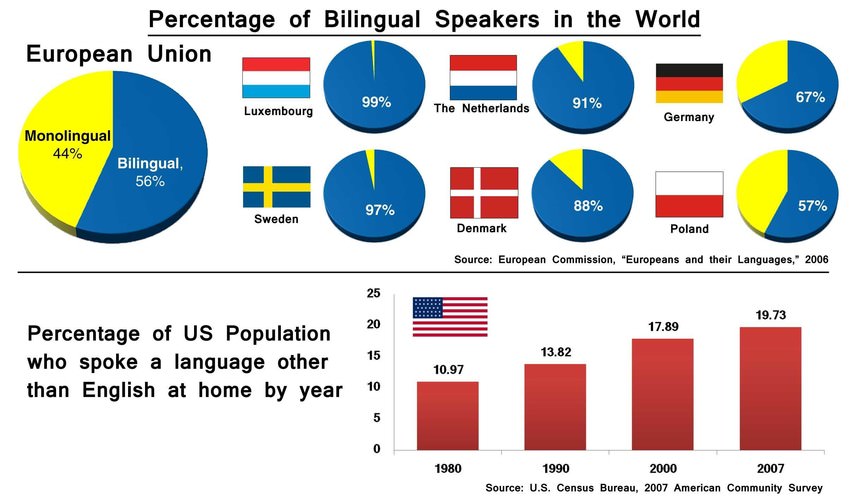
For a long time, investors have emphasised the individual benefits of speaking more than one language. For that people that consider that learning languages is a difficult task, there is the good news that they do not have not to be fluent to feel a positive impact.
Several studies have proved that languages increase the earning power. In Florida, the employees that speak both English and Spanish earn 7,000$ more per year than those that only speak English. Also, according to a Canadian study, bilingual men earn 3,6% and bilingual women a 6,6% more that their equivalents that only speak English.
“It seems that you do not have to speak a second language at work in order to get the financial rewards of being bilingual”, states the economics Professor Louis Christofides, one of the authors of this study. The authors speculate that this could be due to the fact that knowing a second language, a sign of cognitive power, perseverance, and a good education could be observed.
Beyond these immediate financial rewards, learning languages can help to the labour force of a country in a long-term and subtler way. For example, it has been proved that multilingualism has brain health benefits, which delay the onset of dementia. It has been also associated with a improved capacity of concentration and information process. These effects are greater marked on that people who were multilingual from an early age, but nevertheless a later acquisition of languages also constitutes an advance.
«Even a week-long intensive language course improved the attention and this effect was stable after nine months in those who practised five hours per week or more», claims Thomas Bak, Psychology Professor at the University of Edinburgh, and Dina Megmedbegovic, Education Professor at UCL, in an article on the value of the linguistic diversity.
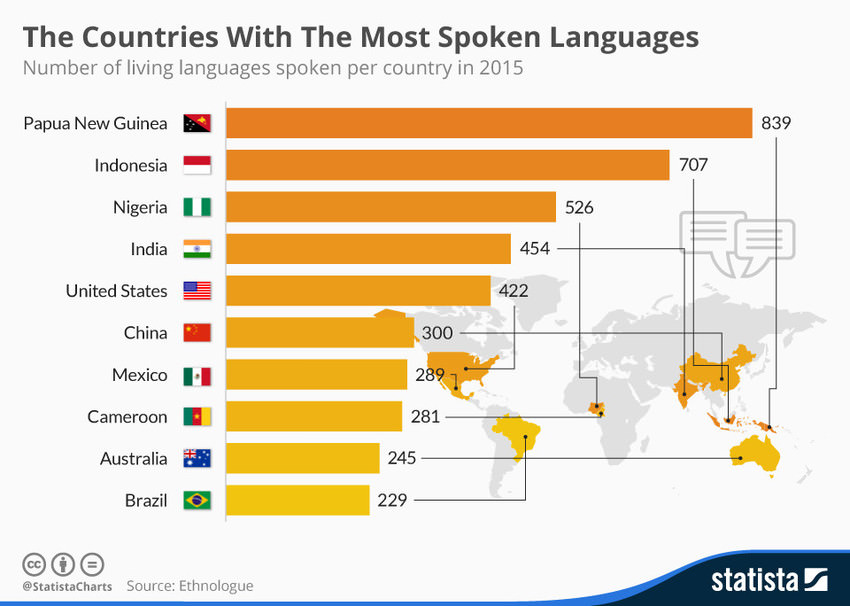
Then, how can countries boost their linguistic capital? Bak and Mehmedbegovic employ the term «linguistic healthy diet» to describe a positive approach of languages over a lifetime.
«In addition to taking every opportunity to say: “It is good for you to eat fruits and vegetables every day”, schools must also say: “Is good for you to speak, read, and write in different languages”», they suggest.
This is especially important since many countries already have a vast linguistic resource undeveloped in the form of immigrant families. But while many monolingual parents encourage their children to take language classes, immigrant parents may feel discouraged to transmit their own language for fear of discrimination, or because they think that multilingualism is detrimental.
Taking into account that linguistic diversity conveys a powerful economic impact, it is alarming that many languages have a serious risk of extinction. The most vulnerable ones are the languages spoken by small communities in mountainous areas. According to the researchers, the main drivers of its decline are the globalization and the high economic growth