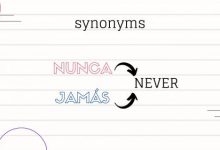

NUNCA vs JAMÁS
Today we’re going to explain the difference between nunca and jamás. They are synonyms, i.e. they have the same or almost the same meaning; the slight difference between synonyms is defined by the context in which they are used, or by certain connotations, underlying meaning, emotions, or details. We can affirm that jamás is more emphatic than nunca; it’s like absolutely ever in English. Look at the examples:
-
- Yo nunca he trabajado en la empresa de mis padres. [I’ve never worked at my parent’s company.]
- Nunca te lo perdonaré, Miguel… ¡jamás! [I will never forgive you, Miguel… ever!]
Both nunca and jamás mean that something has not happened in the past or will not happen in the future (including both, immediate and long-term future).
Hereunder, you can find some special ways to use the adverb nunca. Since the following information is more complicated and belongs to an advanced level, we recommend using the following combinations once you have fully understood the difference between nunca and jamás and use them correctly. Trying to learn every use of nunca at once can be very confusing.
-
- Nunca más (never again, nevermore) — It means that something has already happened in the past, but will not happen again in the future. E.g.: Me han antendido fatal en esta tienda, así que no volveré nunca más [In this shop, I’ve been attended very poorly, so I’ll never come back].
- Nunca jamás (never ever or never again) — It’s a more emphatic and emotional way to say nunca más (i.e. we won’t repeat an event or act in the same way in the future). It’s frequently used to refer to mistakes we’ve made in the past that we regret. For instance: ¡Nunca jamás le volveré a llamar! [I will never call him/her again!]
- Nunca antes (never before) — It means that something has occurred for the first time. E.g.: Nunca antes había hecho surf [I’ve never surfed before]
- Nunca más (never again, nevermore) — It means that something has already happened in the past, but will not happen again in the future. E.g.: Me han antendido fatal en esta tienda, así que no volveré nunca más [In this shop, I’ve been attended very poorly, so I’ll never come back].